


Balancing Structural Integrity and Efficiency in Customized Steel Formwork Designs
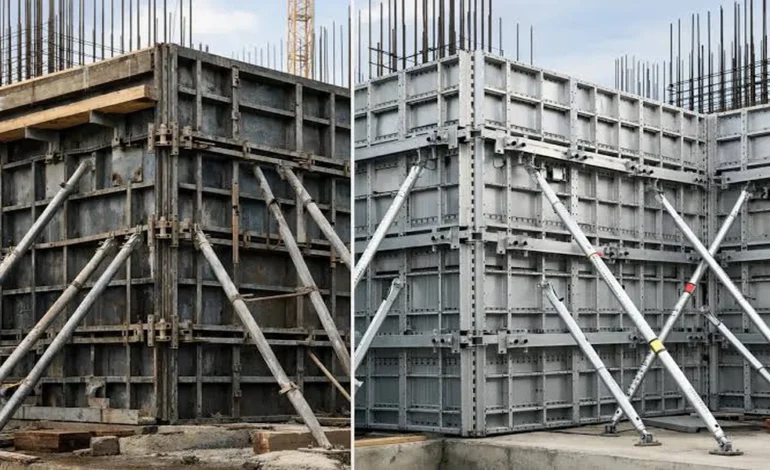

No one ever marvels at the steel skeleton behind a flawless concrete curve, yet the quiet genius of customized steel formwork defines the skyline, shapes the infrastructure, and drives real-world economies. It’s here, beneath the surface, that structural integrity and operational efficiency go from theory to necessity, especially when every ton of steel and hour of labor must justify its place.
Early Foundations of Steel Formwork Design
The origins of steel formwork trace back to a time when wood dominated the trade. As concrete structures grew in scale and complexity, the limitations of timber, warping, inconsistency, and limited reuse, became impossible to ignore. Engineers began to favor steel for its strength and durability, yet early adoption brought forth a new dilemma: how to balance the raw power of steel with the demand for cost-effective construction?
Initial Challenges Balancing Strength and Material Use
Designers faced a persistent tension: overbuild and the project loses efficiency; underbuild and structural failure looms. Early methods were cautious, often relying on conservative assumptions that guaranteed safety but at the cost of material waste and extended schedules.
Early Methods for Calculating Lateral Pressure and Load
In early high-rise and bridge projects, calculating lateral pressure depended on broad estimates, often using the maximum possible pressure from wet concrete, regardless of pour speed or temperature. This blanket approach led to massive over-engineering, multiplying the need for tie rods, bracing, and heavy steel.
Advances in Structural Analysis and Material Science
Over the past decades, formwork engineering has undergone a quiet revolution. The ability to accurately model the relationship between concrete pouring speed and temperature now allows for precise adjustments in formwork design. For instance, on tall walls, differentiating between a cautious assumption of pressure and a realistic, data-driven one can mean saving several rows of tie rods, translating directly to substantial reductions in steel usage, labor, and time.
Evolution of Load Calculations for High Walls and Large Elements
Today’s engineers leverage a nuanced understanding of concrete behavior to fine-tune designs. The result? Highly optimized formwork that supports immense forces only as long as necessary, then moves on to the next pour with minimal material left idle.
Impact of Improved Steel Grades and Fabrication Techniques
Advancements in steel manufacturing have introduced higher-strength alloys and better fabrication processes. These metrics are not just numbers in a spec sheet; they enable lighter, more slender formwork that still meets demanding strengths, especially in cases where dead load reductions drive project feasibility.
Customized Steel Formwork for Complex and Repetitive Architectural Forms
Modern architecture increasingly demands complex shapes, vaults, tunnels, and multi-faceted facades that standard solutions cannot address. When a project repeats the same geometry across multiple uses, investing in a custom steel formwork pays dividends almost instantly. Each reuse spreads the initial cost thinner, turning a hefty up-front investment into a competitive advantage.
Lightweight Solutions for Unique, Non-Repetitive Shapes
However, not all architectural bravado repeats. For unique forms, the focus shifts to making the solution as light and modular as possible, minimizing the load on supporting elements and easing installation.
Integration of Multi-Stage Shoring and Re-Shoring Strategies
As buildings and bridges stretch taller, effective load transfer becomes a dance of precision timing. Removing formwork too soon risks disaster; waiting too long gums up the entire project schedule. Multi-level shoring strategies, combined with careful analysis of slab and deck capacity, dictate exactly when and how supports can be safely withdrawn or repositioned.
Case Studies: Multi-Level Slab Support and Bridge Decks
Projects involving multi-story slabs or heavy bridge decks demonstrate the value of sophisticated re-shoring analysis. By modeling the redistribution of loads throughout the construction process, engineers can minimize the number of shoring levels needed, slashing material costs and labor hours.
Modern Computational Tools in Formwork Design
The digital era has transformed analysis. Structural modeling software simulates not only traditional loads but also atypical sequencing, crane installations, and even temporary supports for seismic events. No longer do engineers rely on “one size fits all” assumptions; instead, they can pinpoint stress concentrations and optimize reinforcement with remarkable accuracy.
Balancing Efficiency with Safety and Structural Integrity
Chasing efficiency should never compromise structural safety. The best formwork solutions balance lean material use with robust contingency, avoiding both penny-wise risks and the expensive bloat of over-engineering. In practice, this means constant collaboration between engineers and contractors, sharing data, reviewing site conditions, and adjusting designs in real time. Professionals like NadeauSDM ingénieur étaiement exemplify this approach, providing expert analysis that ensures both safety and productivity.
Future Trends in Customized Steel Formwork
Looking ahead, automation and prefabrication promise to accelerate installation and reduce errors. Smart materials, equipped with embedded sensors, could offer real-time monitoring of stress and deflection, catching problems before they escalate. As sustainability takes center stage, lifecycle analysis will increasingly guide material selection and reuse strategies.
Conclusion: The Path Forward for Steel Formwork Design
The challenge is eternal: push the boundaries of efficiency while upholding the non-negotiable standard of structural integrity. Each advance, whether in computation, materials, or process, brings us closer to that elusive equilibrium. As architecture grows more complex and schedules more aggressive, the art of formwork engineering will remain central, demanding an ever-sharper balance between creativity, discipline, and collaboration.